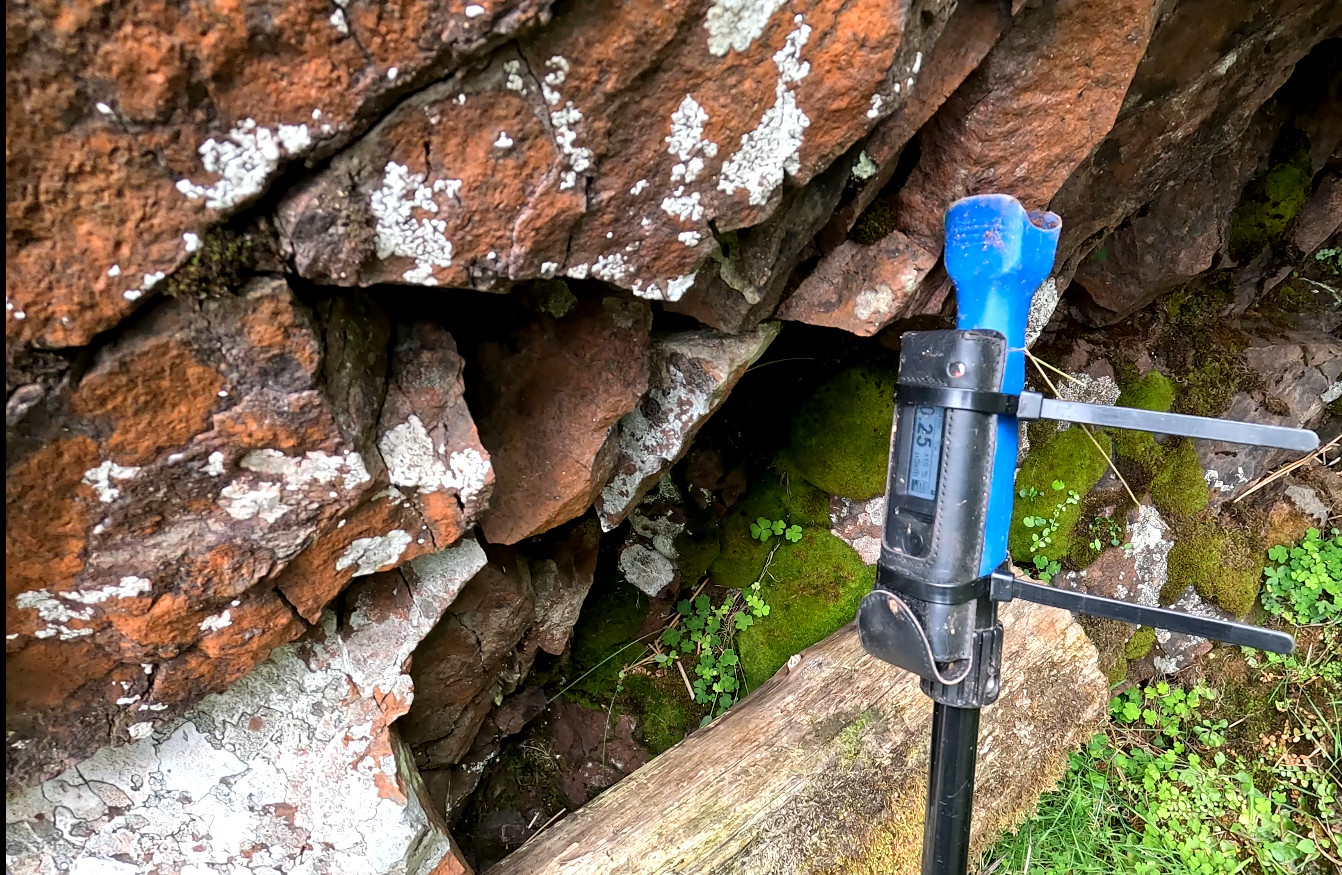
This blog accompanies the new YouTube video “The Breamish Valley: Secret Waterfalls & Forbidden Radioactivity – The Three U’s Challenge (Part 2)” – check it out now.
Reading the Scars of the Caledonian Orogeny
420 million years ago, a continental collision between ancient Avalonia and Laurentia, resulted in the formation of the current British Isles. The buckling of the two continental plates formed many mountain ranges in Southern Scotland and Northern England.
The original rocks that underlay the Cheviots formed in this event, but then a massive volcano formed, bursting through the original rocks. Subsequent magma intrusions, forming the Cheviot Pluton, occurred in several phases, or pulses, of magma during the Lower Devonian period. The constant heating and cooling of rock created cracks both in the pluton and on the edges, causing fissures and faults.
The Cheviots have many faults, from small-scale fissures to miles-long cracks directly in the Earth’s crust. The Breamish Fault, a fundamental NW-SE trending fracture running through the heart of the massif, is far more than just a structural boundary; it is a geological artery that supplied hydrothermal fluids and deposited metals over millions of years, much of which remains hidden beneath the surface.


The Caledonian Orgogeny – a formation in stages
Section 1: The Breamish Fault – A Major Structural Artery
The Breamish Fault is a significant crush zone that follows the upper part of the River Breamish. Faulting in the Cheviots was established soon after the intrusion and consolidation of the Cheviot Pluton. The area’s structural history is complex, involving compression that generated tear-faults. The movement along the Breamish Fault may have been conjugate sinistral (meaning one side moved left of the other).
The fault crosses close to the south-western margin of the Cheviot Granite. The River Breamish’s upper 2.5 miles (approx. 4 km) runs along this crush zone.
Despite its size, the fault can be subtle on the surface. Geophysical surveys show a small negative magnetic anomaly over the Breamish Fault.
This anomaly indicates that the granite is thin here, suggesting that the original rock was thrown deep underground by the action of the fault. This suggests that the fault is deep-reaching and steeply dipping, not just a surface feature.

Section 2: The Fire Beneath: Why the Fault is Metal-Rich
The original source of heat and metal-rich fluids was the Lower Devonian igneous activity of the Cheviot complex. The porphyritic granite itself was likely an abundant source, as its crystallisation was connected with releasing a large volume of water.
Major faults extending into the basement controlled the location of intrusions and hydrothermal systems. The Breamish Fault acted as a major structural zone that localised the hydrothermal alteration effects.
The mineralising fluids that circulated through the Cheviot Hills exploited fundamental structural weaknesses, such as the Breamish Fault and the Gyle-Harthope fractures, which are believed to be deep-seated and exert a major control on the distribution of alteration and mineralisation.
Geochemical surveys of stream drainage and rock samples from areas localised along these structural conduits, particularly the Breamish Fault Zone, reveal widespread enrichment in a polymetallic suite of elements.
The presence of these multiple elements is attributed to complex, polyphase alteration and mineralising events linked to volcanism, associated porphyry intrusion, and the emplacement of the Cheviot Granite. The wide range of metals found in the Breamish Fault Zone confirms its role as a geological artery that facilitated fluid movement.
Section 3: Geochemical Evidence of Undocumented Mineralisation
The greatest support for the fault’s importance comes from regional geochemical surveys, which identified mineralisation far more widespread than previously documented.
- Polymetallic Anomalies: The Breamish Fault Zone is recognised as a specific mineralised area. Geochemical surveys show element enrichments in this zone, including Arsenic (As), Copper (Cu), Lead (Pb), Bismuth (Bi), Zinc (Zn), Antimony (Sb), and Molybdenum (Mo).
- Documented Gold: Native gold was observed in panned concentrates at two locations within the River Breamish catchment: High Bleakhope and Shank. Both sites are situated near the Breamish Fault. This suggests the fault hosted fluids capable of depositing precious metals, confirming its prospectivity for epithermal mineralisation.
- Direct Evidence: a visit to Cow Cleugh, a tributary of the Breamish River, revealed a mineralised area plus several mineralised rocks in the stream. We observed mineralisation on a 100-metre section of the Breamish north of High Bleakhope.


Section 4: Why the Mineral Wealth Remains Undocumented
The reason these rich geochemical signatures do not correspond to visible mines or mapped veins is largely due to concealment and the nature of the terrain.
- Glacial Overburden: Much of the high ground is covered by hill peat. Glacial deposits, including head, scree, and boulder clay, are widespread across the uplands, effectively masking the bedrock.
- Lack of Exposure: Rock exposure is typically poor in the uplands, especially on the steep, peat-covered slopes. Surface weathering and alteration (supergene leaching) have often destroyed or obscured the primary mineral structure.
- Remoteness: The Breamish Fault is inaccessible to public vehicles and is only reached by a 4-mile hike. Access to large parts of the area is restricted.
- Reliance on Geophysics: Because the mineralisation is hidden beneath meters of cover, traditional geological mapping (which relies on visible outcrop) is ineffective. The only way to find these undocumented occurrences is through integrated, remote techniques such as geochemistry and ground geophysical surveys.

Conclusion: The Breamish Fault as an Underexplored Polymetallic Corridor
The Breamish Fault remains one of the most promising, yet underexplored, mineralised corridors in the Cheviots. It concentrates a rich and diverse polymetallic array of metals.
This suite includes Base Metals such as Copper (Cu), Lead (Pb), and Zinc (Zn); Vein and Gangue minerals like Barium (Ba); and Precious Metals including Gold (Au). It also concentrates Radioelements (Uranium (U)) and a variety of Exotic Trace Metals detected in heavy mineral samples from the area, such as:
Metals with high demand for this steel-strengthening properties:
- Niobium (Nb)
- Molybdenum (Mo)
- Tungsten (W)
High-Tech & “Green” Critical Metals
- Yttrium (Y) – used in LEDs
- Antimony (Sb) – used in flame-retardant products
Evolving & Specialised Demand
- Cerium (Ce) – catalysts and polishing
- Bismuth (Bi) – pharma and lead-replacements
The undocumented nature of this wealth is a function of geology protecting its secrets. Exploration of this ancient fault system is less about finding visible mines and more about integrating subtle geochemical and radiometric data to map the hidden corridors, offering a tantalising glimpse of the Cheviot’s concealed resources.