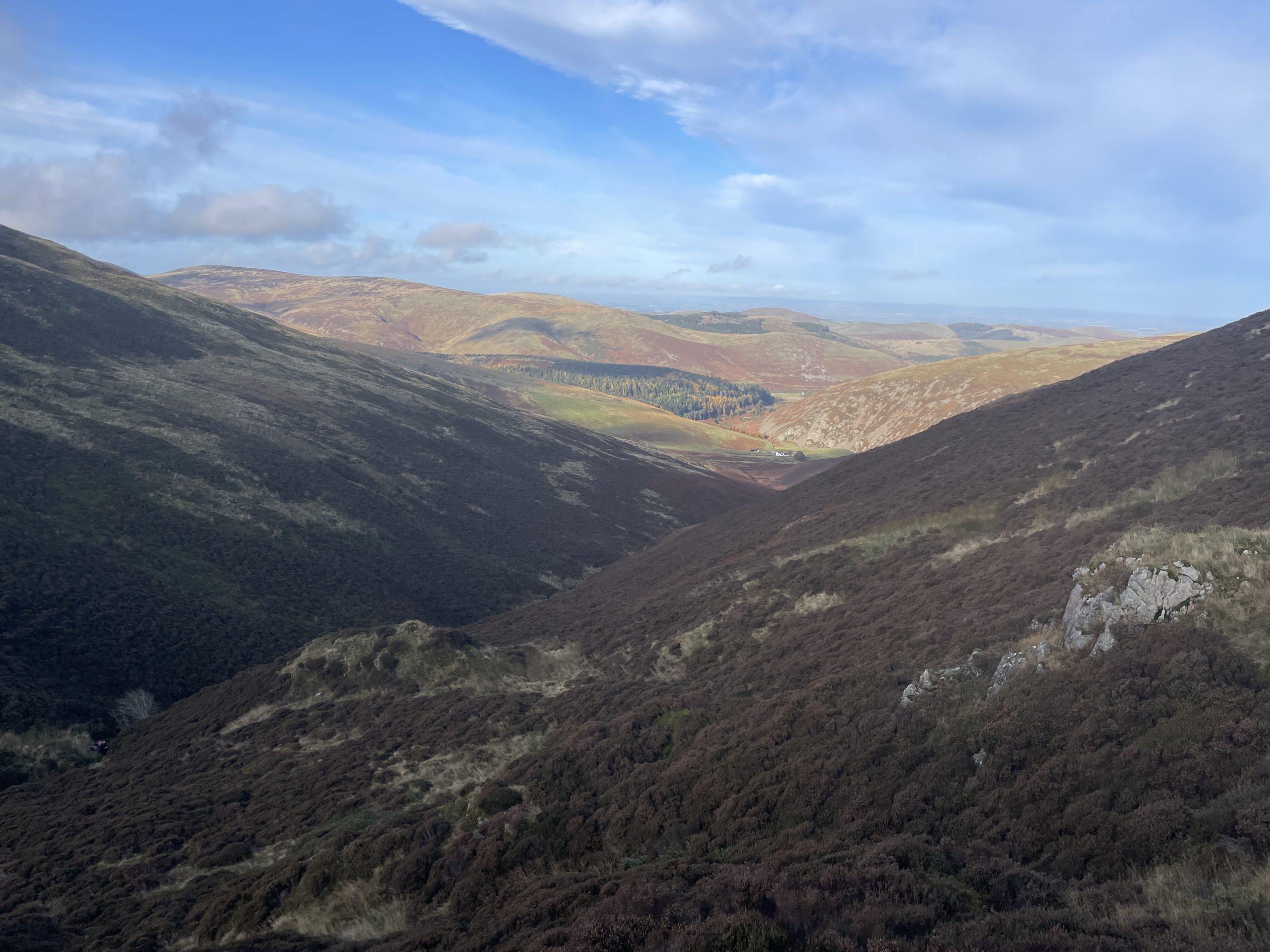
Part 3 of The Three U’s Challenge is now up on Youtube – our visit to Bellyside not only taught us about searching for Uranium, but also about the very nature of the rock here itself. The ‘why’ of why this part of the Cheviots is so radioactive, and its potential for even more valuable metals.
The Concept of Incompatible Elements: The Magma’s Waste Products
When magma cools, it doesn’t just form one continuous mass of rock – like how water forms a clear ice cube. It’s a jumble of many different elements, and each element has its own chemistry.
The simpler minerals formed first – pyroxemes and feldspars. Primitive chemically, they form deep beneath the surface as cooling begins. Made up of common elements such as Silicon, Aluminium and Calcium, they are the foundations of this cooling process.
However, as cooling continues, there are other elements that cannot easily join these minerals. The base minerals have structures which are not suitable for them – they are incompatible. So as the magma continues to cool, these elements are kept in the liquid magma, being concentrated together.
Amongst these elements are Uranium (U), Thorium (Th), Rubidium (Rb), Niobium (Nb), and Rare Earth Elements (REE). They are collected at the very top of the magma, and because they are the last to solidify, they are most easily mobilized by later fluids into veins and fractures (which is why we find high Uranium readings). This process has a name: Fractional Crystalisation.

The Evolution of the Cheviot Granite: From Primitive to Perfect
We’ve all seen the videos of magma spewing from volcanoes, solidifying on the surface as bubbling grey blobs. But what happens when you have a vast body of magma, extending over 200 square kilometres beneath the crust, and rising to within 2km of the ancient surface? That’s what the Cheviot Pluton, the deeply buried remnant of a massive volcano, was 380 million years ago.
In my videos I mostly refer to the rocks of the Cheviots as ‘granite’, but the situation is far more complex than that. In fact, the area I explored at Bellyside was the only true granite to be shown as part of the Three U’s Challenge.
Imagine it was a column, the column would contain many layers, each layer a different type of rock. As we’ve learnt about incompatibles, we know that cooling magma does not form a single type of rock. In the Cheviots, geologists have studied this in great detail and outlined the phases of the Pluton’s solidification. They may look like plain rocks to the untrained eye, but they tell the story of at least six phases of intrusion and solidification.
• The Magmatic Sequence (Least Evolved to Most Evolved):
◦ Least Evolved: The earliest magmas were the Marginal and Dunmoor Granodiorite. These phases are the most chemically basic and contain lower concentrations of incompatible elements.
◦ Intermediate Phases: This was followed by the eruption of the Standrop Granodiorite, Linhope Granodiorite and Hedgehope Granodiorite. These phases show a clear progression toward more evolved compositions.
◦ Most Evolved: The Woolhope Granite is the last intrusive unit to solidify within the Cheviot Pluton. It is chemically defined as a true granite – rich in quartz – contrasting strongly with the earlier granodiorites.
The Woolhope Granite: The Magnet for Incompatible Elements
Because the Woolhope Granite is the last liquid from the magma chamber, it inherited the highest concentrations of elements rejected by the earlier, more abundant granodiorite crystals. That’s our Uranium and other heavy elements. This late-stage differentiation is responsible for the strong contrast in chemical analysis between the Woolhope and other minerals further down the Pluton.
The Woolhope Granite is found at the highest part of the complex. Even though much of the original Pluton has eroded away, sheets of this granite still remain today. Minus a small patch of andestie, the very top of The Cheviot – the highest peak in the range – is made of Woolhope.
The Woolhope Granite veins are found intruding the surrounding older Marginal and Dunmoor Granodiorites (e.g., at Bellyside Hill and Dunmoor Hill – near Linhope). This contact allows the incompatible-element-rich fluid released during the Woolhope’s crystallisation to migrate outwards into faults and fracture zones, setting the stage for mineralisation.

Mineral and Metal Potential: Radioactives, Gold, and Rare Earths
The highly evolved, incompatible element-rich nature of the Cheviot magmatism, particularly associated with the final Woolhope phase, resulted in the concentration of valuable metals, now found along structural conduits like the Breamish Fault Zone – featured in Part 2 of our video series:
• Radioactive Elements (U & Th): The Cheviot Granite is classified as a radioelement enriched late Caledonian granite. The Woolhope Granite has high Uranium and Thorium levels, reflecting its highly fractionated status. These elements are held in primary accessory minerals within the granite. That explains why readings were consistently high at Bellyside, not just at the mineralised zones.
• Native Precious Metals (Au): The hydrothermal systems driven by this late magmatism are prospective for epithermal precious-metal style mineralisation. Native Gold (Au) has been found in the Breamish and Kingsseat areas.
• Rare Earth and Critical Metals: Differentiation concentrated exotic trace elements found in heavy mineral concentrates from the Cheviots:
◦ Niobium (Nb) and Tin (Sn) are noticeably richer in concentrates derived from the Cheviot granite.
◦ Molybdenum (Mo), Antimony (Sb), and Yttrium (Y) are confirmed anomalies in the mineralised areas.
◦ Cerium (Ce), a Rare Earth Element, is enriched in panned concentrates but not in the Woolhope Granite itself. This is because other incompatible elements captured Cerium in minerals such as zircon and apatite, trapping it before final formation of the Woolhope Granite.
So if you are ever exploring the Cheviots and you get high amongst the hills, don’t just look at the surrounding rock as one big monolithic structure. Look at their differences in colour and texture. It’s that difference that reveals why we find radioactive minerals and even precious metals amongst till and tundra.