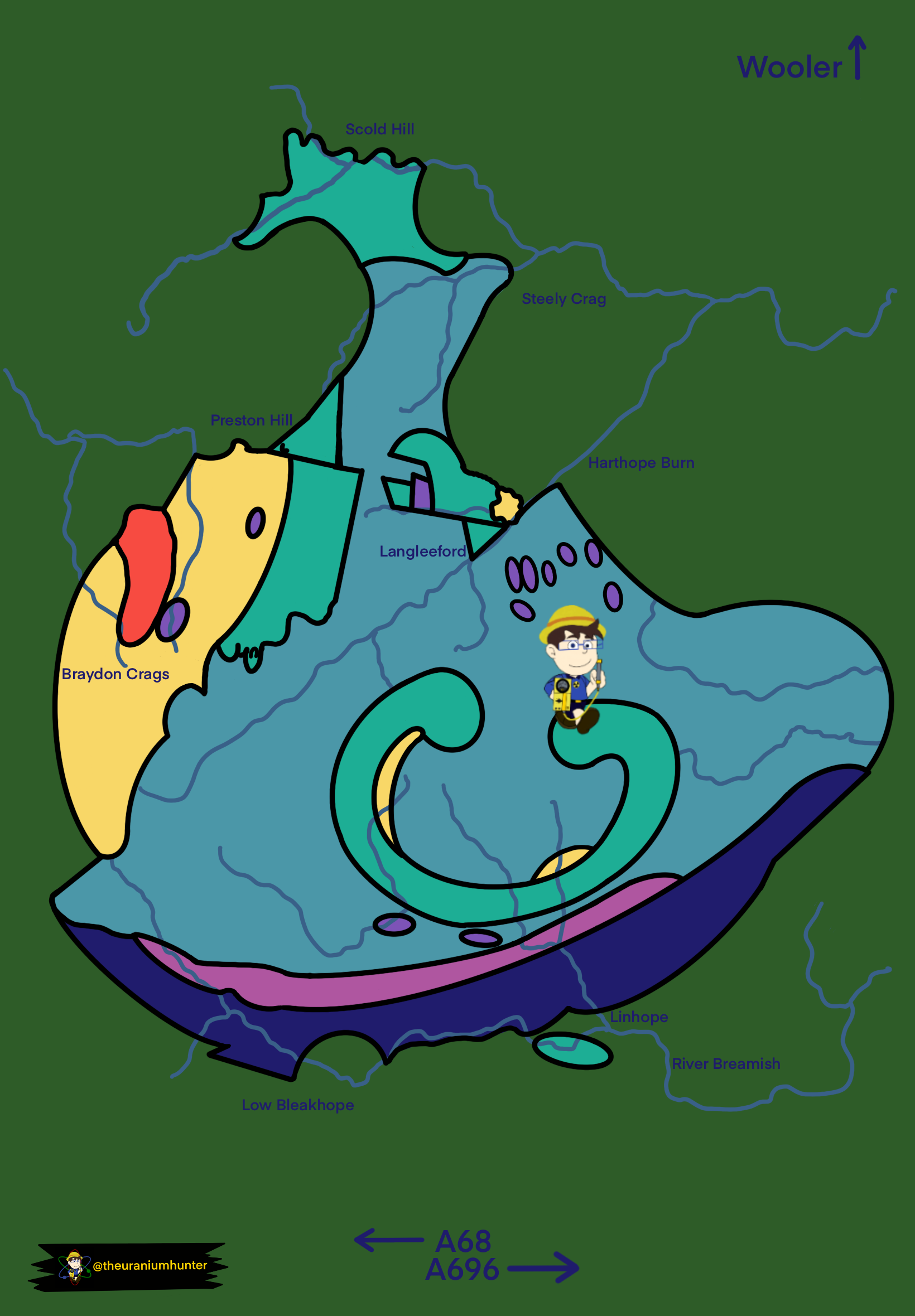
The Cheviot Hills, straddling the border between England and Scotland, are the remnants of a substantial Lower Devonian volcano. Amongst the fascinating geological features of this area is the concept of ring dykes and a zoned plutonic complex, a theory that attempts to explain the structure and evolution of the Cheviot igneous rocks. But while the idea of these “rings” offers a compelling narrative, the full picture, as revealed by various geological investigations, is more nuanced and still requires further investigation.
The Common Theory: Concentric Intrusions
The prevailing theory suggests that the Cheviot complex was formed by multiple phases of igneous activity, potentially involving the intrusion of granodioritic and granitic rocks in a roughly concentric or ring-like pattern. This model often envisions a sequence where earlier, more basic intrusions are followed by later, more evolved ones, potentially forming ring dykes.
- Jhingran (1942) distinguished three types of granite in the Cheviot Hills: a more basic ‘Marginal’ variety, a more felsic, course-grained ‘Standrop’ variety, and a ‘Granophyric’ variety. This initial classification hints at a compositional zonation within the pluton.
- The Cheviot memoir (Carruthers et al., 1932) also recognized variations within the granite mass and the possibility of multiple intrusions, though they regarded the Cheviot granite as a single intrusion due to a lack of definitive evidence from the limited exposures.
- Later work on the alteration petrology of the Cheviot Granite refers to two major cycles of igneous activity, with intrusions such as the Marginal and Dunmoor Granodiorites in the first cycle, and the Standrop, Linhope, and Porphyritic Hedgehope Granodiorites in the second. The association of hydrothermal circulation with the intrusion of the Dunmoor and Hedgehope Granodiorite ring dykes further supports the idea of distinct intrusive phases.
Divergent Answers and Ongoing Debates
While the concentric intrusion model provides a framework, the sources also highlight complexities and alternative viewpoints:
- Mapping challenges: The scarcity of rock exposures due to extensive peat deposits and glacial drift makes it difficult to definitively trace the continuity and boundaries of different rock types. As a result, constructing a detailed and universally accepted geological map showing clear concentric zones has proven challenging.
- Intermingling of rock types: Modern mapping efforts, have found quartz-rich granite in both marginal and central locations, and mafic ‘Marginal’ type rock centrally, indicating that the distribution of rock types is not always strictly concentric. This suggests a more complex intrusive history than a simple series of ring dykes.
- Contamination vs. Distinct Intrusions: Early researchers debated whether the variations in the Cheviot granite were primarily due to contamination by the surrounding andesitic lavas or due to multiple, distinct intrusions. While Jhingran (1942) believed the lavas caused little modification, the Survey memoir proposed that basification occurred through lava absorption. Later, the assimilation of Silurian greywacke and shales by the granitic magma was also suggested as a potential cause of contamination in the marginal variety.
- Geophysical interpretations: Magnetic surveys have been conducted to understand the subsurface structure of the Cheviot complex. However, interpreting these potential field data is inherently ambiguous, and while models can be created to satisfy the observations, they are not unique. Further geophysical data, such as gravity or seismic surveys, are needed to provide more robust constraints on the subsurface geometry.
- Relationship to Caledonian Granites: The Cheviot pluton is considered part of the late Caledonian igneous province. Comparisons with other Caledonian granites, such as those in the Southern Uplands (e.g., Criffel, Fleet) and the Lake District, suggest potential similarities in magma sources or evolutionary processes. However, the Cheviot also exhibits unique characteristics, and further work is needed to fully understand its place within the regional magmatic framework.
Why does it matter for the Uranium Hunter?
The internal structure and potential zonation of the Cheviot Granite – is important for us. Different zones within the granite could have varying uranium concentrations, host different uranium-bearing minerals, and potentially be associated with secondary uranium enrichment. Understanding these “rings” through geological mapping, geochemical surveys, and mineralogical studies would be crucial for targeted and effective uranium exploration in the Cheviot area.
Conclusion: The Need for Further Investigation
Despite decades of research, the “rings” of the Cheviots, while a useful conceptual model, remain a subject of ongoing investigation and debate. The complex interplay of multiple intrusive phases, potential contamination processes, and the challenges of mapping in an area with limited exposures means that a complete and universally accepted understanding of the Cheviot’s internal structure is still elusive.
Further research, potentially involving detailed geochemical and isotopic analyses, high-resolution geophysical surveys, and integrated geological mapping, is crucial to unravel the intricacies of this fascinating volcanic complex and to definitively determine the nature and significance of its “rings.” Only then can we fully appreciate the geological history locked within the Cheviot Hills.