This blog and Part 2 accompany the new YouTube video “Linhope Spout: The Waterfall Hiding Radioactive Secrets – The Three U’s Challenge (Part 1)” – check it out now.
Meet Dr. Hugh William Haslam & his 1975 “Cheviot Scan”
Dr. Hugh William Haslam (1934‑2009) was the go‑to expert on Britain’s twisted, high‑temperature rocks. After earning a PhD from Cambridge in 1961, he spent most of his career at the British Geological Survey, helping to untangle the history of the Caledonian mountain‑building that shaped Scotland and northern England.
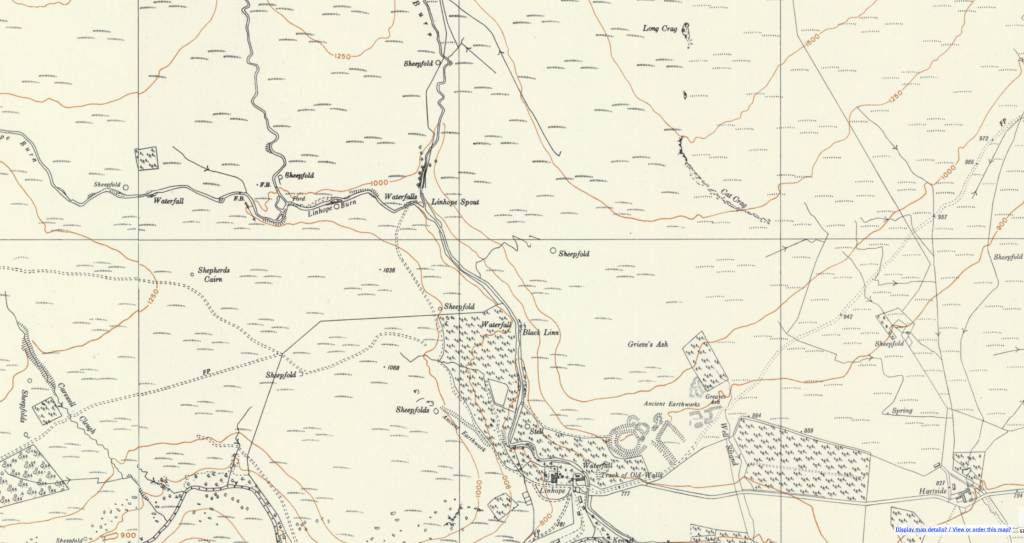
In 1975 he published a landmark report titled “Geochemical survey of stream waters and stream sediments from the Cheviot area” (Report No 75/6). The study was essentially a nationwide “radar sweep” of the Cheviot Hills – a 1970 field trip that collected dozens of water and sediment samples from streams across Northumberland and Roxburghshire.
What the 1975 scan told us
- The goal was to map every inch of the Cheviot granite and the nearby volcanic rocks, with a touch of the older Carboniferous sandstones.
- Scientists measured a handful of key metals – uranium, copper, lead, zinc, barium, iron and manganese – to see what the landscape was hiding.
- They found that the granite itself carries a bit more boron, beryllium, tin and, crucially, uranium than the surrounding volcanic rocks.
- A few hidden “hot spots” emerged: copper‑rich spots in Kingsseat Burn and barium‑rich spots in Usway Burn and the River Breamish.
- Most importantly, the paper flagged tiny, scattered pockets of uranium that were too small or far away to show up in a broad survey.
In short, Haslam’s 1975 scan was the first systematic look at the Cheviots’ mineral inventory, and it left a roadmap of subtle radioactive clues that still surprise explorers today.
The “Three U’s” and Their Modern Exploration Significance
Haslam’s 1975 survey didn’t just map the Cheviot granite – it handed us a treasure map of three tiny uranium clues that slipped past the regional geochemical nets of the day. He flagged three minuscule but unmistakable concentrations:
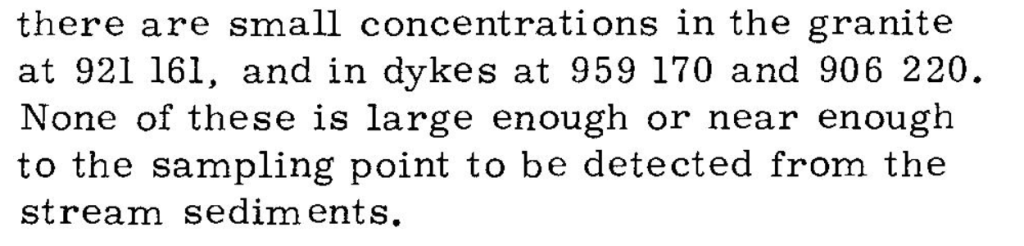
- A pocket in the granite itself at grid 921 161.
- A dyke‑filled vein at grid 959 170.
- Another dyke‑infiltrated spot at grid 906 220.
Because of their modest size or their distance from the stream‑sediment sampling sites, the paper noted that these “minor mineralisation sites were not detectable from the stream sediments” – the drainage survey simply missed them.
Why this matters for our exploration
The fact that 1975 already hinted at hidden uranium, yet the regional drainage chemistry failed to catch it, tells modern prospectorists that the Cheviot massif still harbours structurally‑controlled, low‑grade uranium that could lie concealed beneath the surface. The “three U’s” sharpen three key insights:
- Uranium is not a uniform dust in the granite; it is locked into discrete structural traps – be it the granite itself or later dyke intrusions.
- Glacial drift and peat blankets over the Cheviots act like a filter, preventing much of the uranium from leaching into the topsoil and rendering surface geochemistry an unreliable guide to ore.
- Targeted, penetrative methods – geophysics to image subsurface anomalies, followed by auger or drill sampling – are essential to bypass the drift and pinpoint these subtle concentrations.
In short, the “Three U’s” remind us that the Cheviots still hold a promising, albeit hidden, uranium story that can only be unraveled with modern, deep‑penetrating exploration techniques.
Linhope Spout – Why the rocks glow
Linhope Burn is a favourite spot on the Cheviot Hills because the water that drains the granite there carries a heavier, richer mix of minerals than the rest of the area
The “radioactive” buzz around the spout comes from a single, dense mineral that loves to trap uranium – zircon.
- Heavy‑metal rich stream beds – Samples from the granite‑draining streams were found to be a little richer in iron, manganese, tin, vanadium and, most importantly, zirconium. The extra weight comes from heavy minerals like iron oxide, tourmaline and, of course, zircon settling in the stream bed
In short, the glow at Linhope Spout is not a mystery vein of uranium‑rich rock but a natural “silo” of uranium‑laden zircon grains that have gravitated to the stream bed. Their dense, crystalline structure keeps the radio‑active elements close, turning the spout into a living laboratory for anyone curious about Earth’s hidden nuclear treasure.
Uranium lives inside zircon – A follow‑up study of the same stream concentrates (Haslam & Leake, 1978) showed that the bulk of the uranium in those samples was locked up inside zircon grains. The researchers noted that the uranium‑rich samples also had very high zirconium levels (over 2,800 ppm) – a classic sign that uranium (and its cousin thorium) is carried by accessory minerals such as zircon and monazite in granitic rocks
Density‑driven concentration – Zircon is heavy (specific gravity > 4), so it sinks to the bottom of the stream and piles up in the spout’s sediment. As a result, the uranium that’s chemically woven into the crystal lattice of these grains becomes locally amplified, giving the spout its detectable radioactivity
Thorium at Linhope Burn vs. Uranium at Linhope Spout
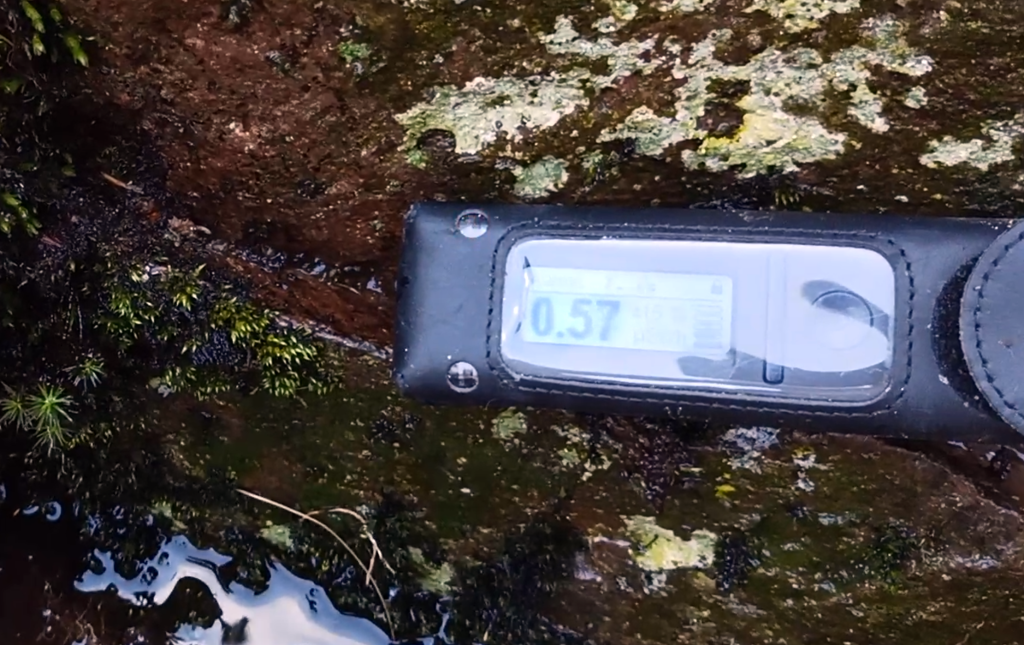
In the Cheviot granites, both uranium (U) and thorium (Th) love to hide inside the same “heavy‑mineral” family – zircon, monazite, thorite and the like. The story is that they start out together, but once the granite begins to weather, the two elements take very different paths to the stream bed.
| What’s the common ground? | What makes them behave differently? |
| Source – Both elements come straight from the Cheviot granite. The detrital heavy minerals that drift downstream (zircon, monazite, thorite) carry both U and Th in their crystal lattices. | Mobility – This is the big twist. Thorium is stubbornly immobile; it stays locked in its host grains (monazite, detrital heavy minerals) and shows up in the stream sediments exactly where those grains come from. Uranium, on the other hand, is a chemical wanderer. In oxidising surface waters it leaches out of weathered granite, then finds its way into the clay‑rich fraction of the sediment or sticks to iron‑manganese oxides and organic matter downstream. |
| What we see in the field | What we see in the field |
| Thorium levels in Linhope Burn sediments reliably echo the local abundance of refractory heavy minerals (zircon, monazite). | Uranium levels at Linhope Spout reflect not only the U trapped in those heavy minerals but also the secondary migration and adsorption of U onto other sediment components farther downstream. |
In short, the thorium measured in Linhope Burn is a faithful “snapshot” of the granite’s heavy‑mineral inventory, while the uranium spotted at Linhope Spout is a mix of that original inventory plus the journey it takes through the stream’s chemistry.