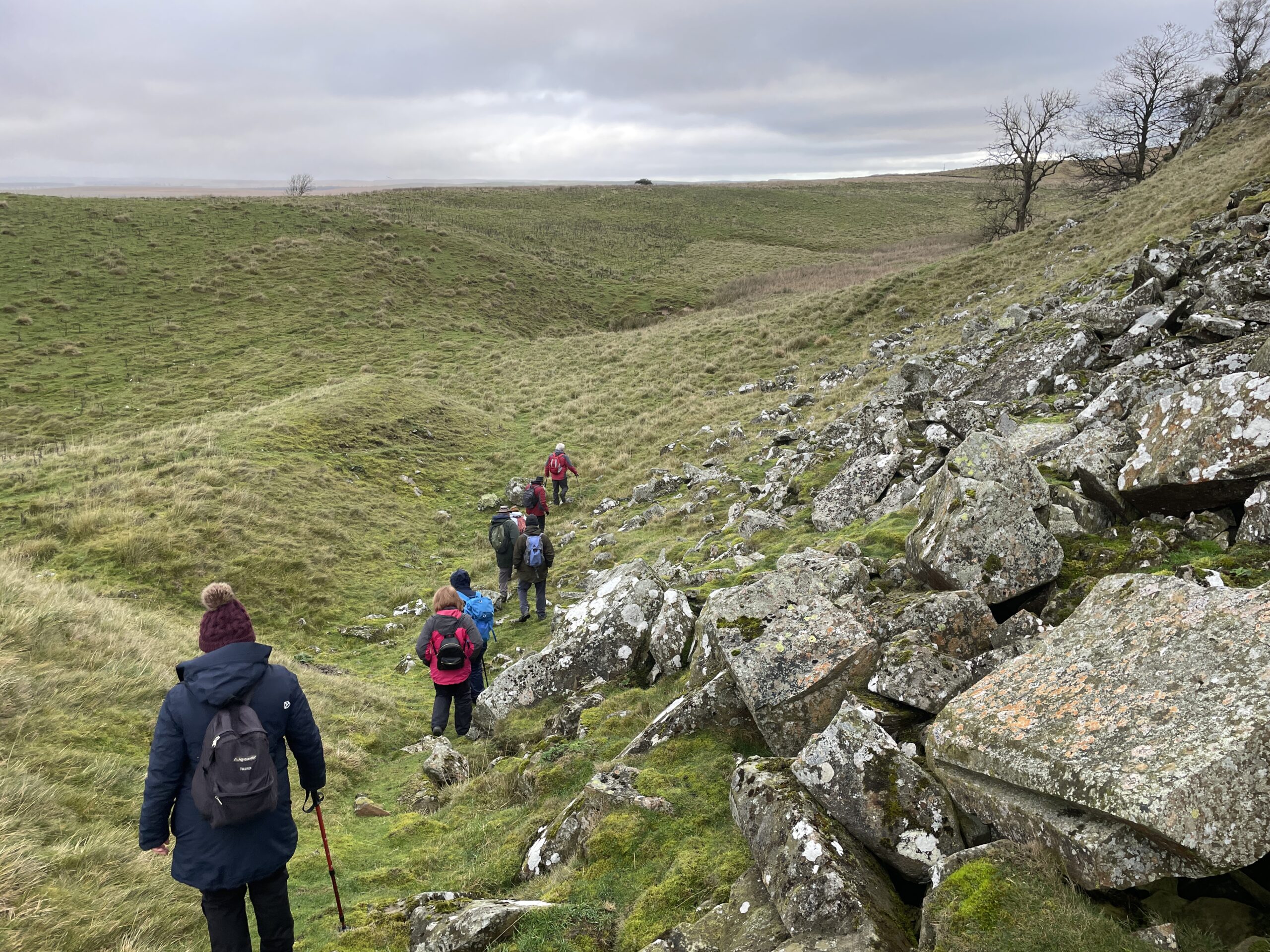
On a foggy Sunday I joined the Open University Geological Society on a trip to explore the Whin Sill. Famous for shaping a large part of Hadrian’s Wall in Northumberland, our guide Karl Egeland-Eriksen took us much further, to stories of how the earth was aged and even of the Earth swallowing proto-planets. I took a detector along, because that is what I do.
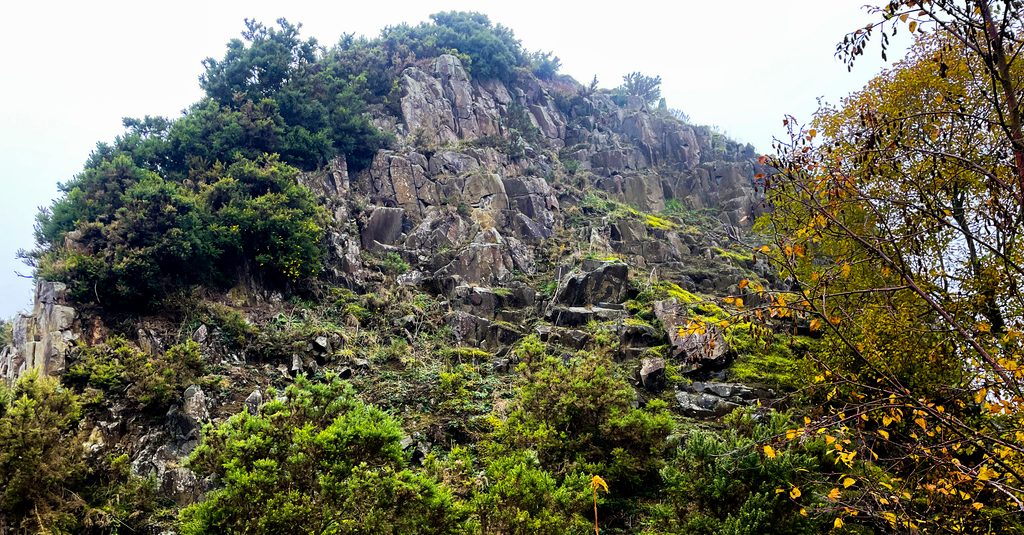
Columnar cooling, yards from the car park
Parking at Walltown Visitors Centre, our first treat was an outcrop of Whin Sill a few yards from the car park. You do not need to go to Fingal’s Cave or the Giant’s Causeway to see columnar jointing. Those hexagonal fractures are an effect of cooling, and they are clear here.
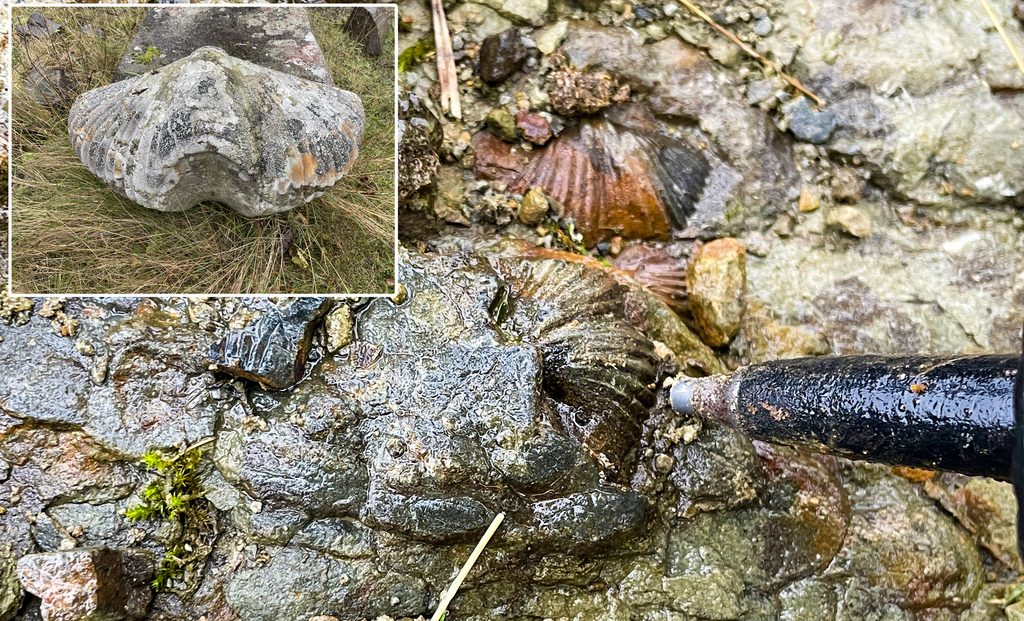
Fossil Crag and the ocean that was here
Our next stop was the aptly named Fossil Crag. Lying in the path were fossils of Spirifer trigonalis, a brachiopod that lived here when this was the floor of an ocean. At the crag is a sculpture to show visitors what the animals would have looked like in Carboniferous times.
Walltown Crags and the fingers of magma
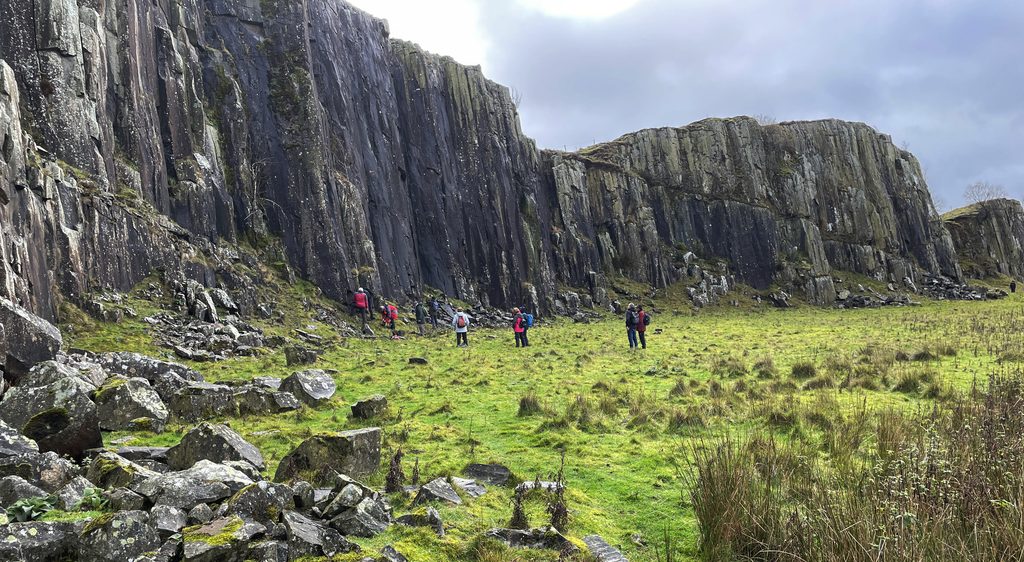
A short walk up a mineral path brought us to the main event, Walltown Crags. Seventy metres thick, this is one of the most notable outcrops of the Whin Sill in North East England. See that pond? No one quite knows what it was for, and it does not appear on nineteenth century maps. The sill is an intrusive rock called dolerite, and it was injected into the older limestone around 300 million years ago.
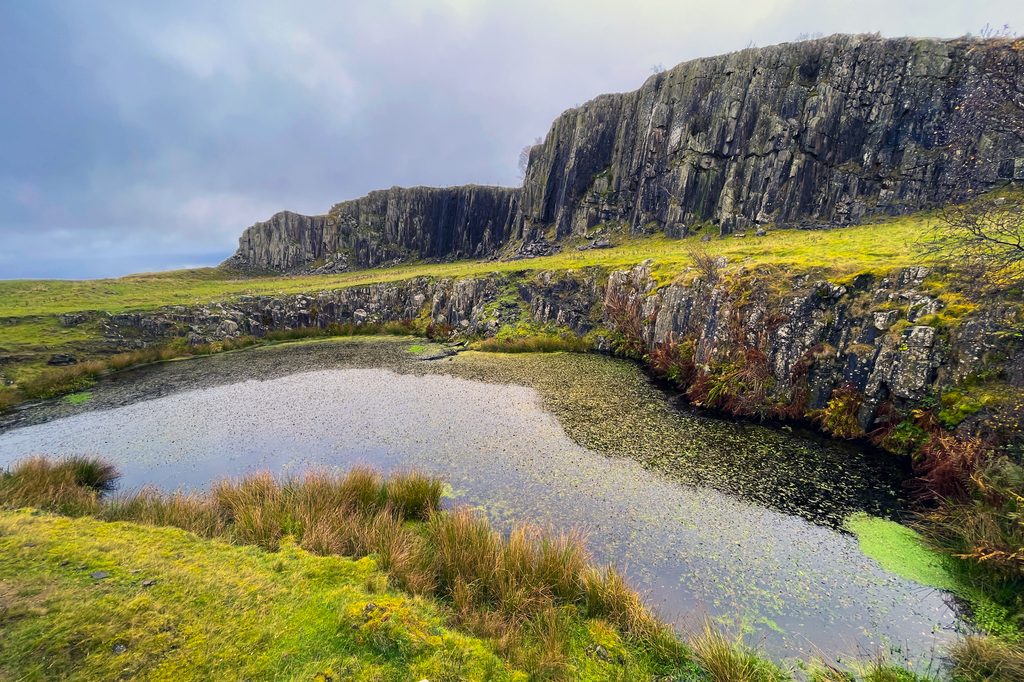
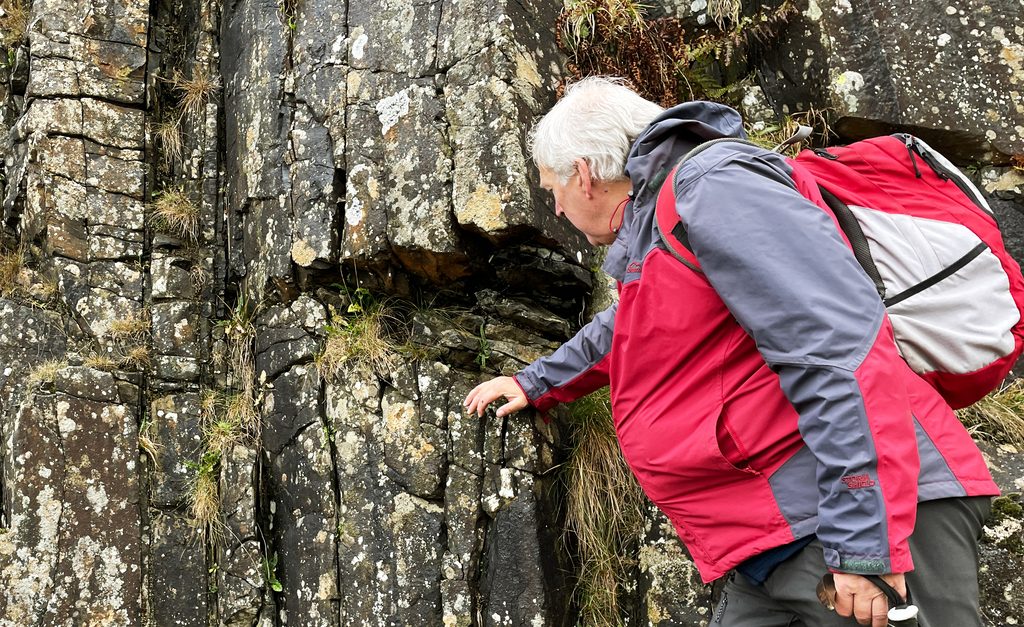
Karl was particularly keen to discuss a brand-new theory. Those roughly horizontal lines look like faults, but they are actually the joins between overlying fingers of magma, and trapped between them is the original, older country rock. Testing has confirmed the theory that the magma spread out in successive lobes rather than intruding in one action.
Arthur Holmes, and a rock with no clock in it
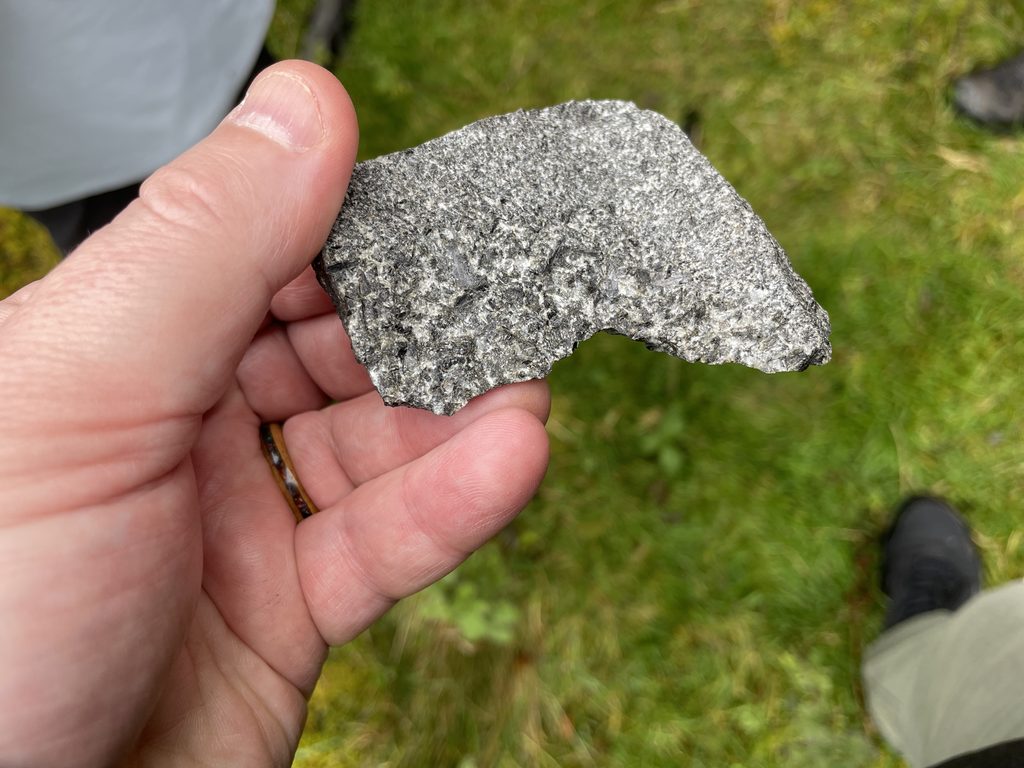
Next came the story I had been waiting for, because it is the reason this rock matters to me at all. Karl told us that Arthur Holmes, the man who taught geology to read the age of a rock, could not date the Whin Sill because the sill has no uranium in it, and that they had to take a sample of gabbro from High Force instead and date the uranium trapped in zircon.
The truth is a better puzzle. The sill is not barren of uranium: the rock Holmes used carried about 0.8 parts per million of it. What the sill has none of is zircon, the mineral that takes uranium in and holds on to the lead, and a dolerite carries none. So there was nothing here to run a lead clock on, and Holmes went at it another way altogether.
In 1929, with S. Dubey, he measured the helium a rock traps as its uranium and thorium decay, and turned it into a number with an equation of his own. He got 182 million years for the Whin Sill against a true age of about 297, and he was honest about why it came out young: helium leaks, so his dates could only ever be minimum ages. The paper is Estimates of the ages of the Whin Sill and the Cleveland Dyke by the helium method, Nature 123, 794.
The rock at High Force is dolerite, which is a name British geology also files under microgabbro, so Karl was not wrong, and the piece he handed me looks paler and coarser in the hand than the sill at Walltown. That is a post of its own.
Karl kindly gave me a sample to see if I could recreate the experiment. Watch this space.
The Theia question
Karl had one last theory and it was the most mindblowing of the lot. He explained that 300 million years ago what became Northern England was close to the equator, and that it was no coincidence that the Whin Sill and other intrusions like it happened at a point that is now northern Africa. The conjecture is that a combination of crustal thinning and the remains of a proto planet, called Theia, buried deep in the Earth’s mantle, is the mechanism for these magmatic events.
The collision of the Earth and Theia spun off what became the Moon. What a story if it is proven true.
A little radioactivity at the contact
The last discovery was one of my own. We were set the task of finding the boundary at Walltown Crags between the Whin Sill and the older limestone, so I ran the Radiacode over the baked rock either side of it. Where there are joins and faults, and especially at a boundary between two rock types, there is often mineralisation, and this one obliged. The reading came back at 0.17 microsieverts an hour, about two to three times the background.
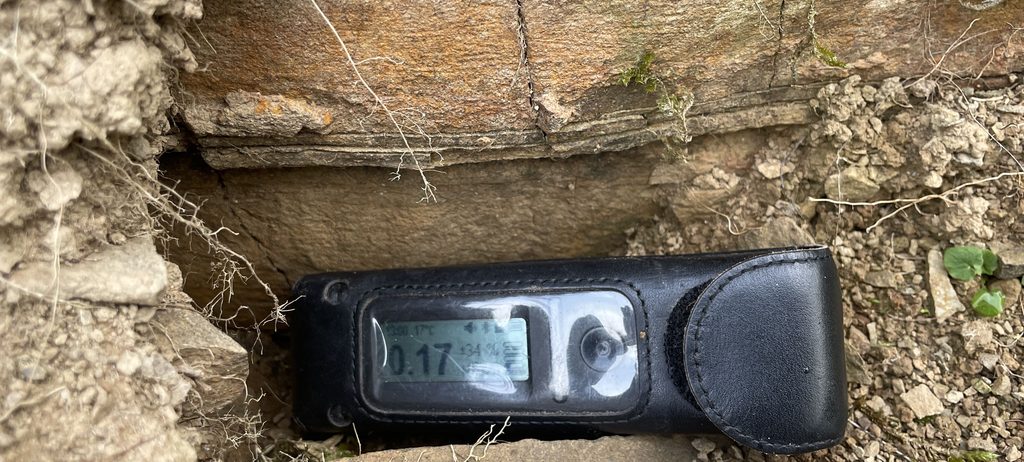
The instrument put a 34 per cent error on that, and it is right to: at those levels it is counting a handful of events, so the number is a hint rather than a measurement. A hint is enough to be a reason to come back.
The lime kiln at the foot of the quarry
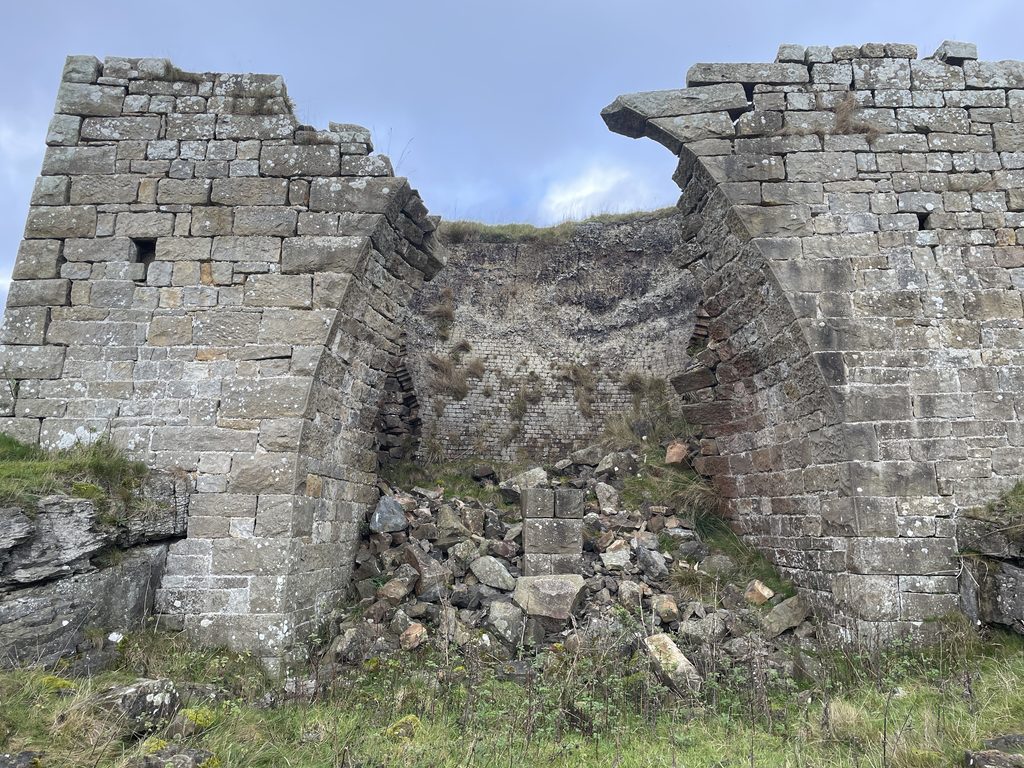
On the path back we stopped at this lime kiln. It sits at the front of a limestone quarry and it is a fine example of intelligent construction, because everything it needed was close at hand. The lime came out of the quarry, the coal came from seams nearby, and the walls are built from sandstone and Whin. Lime mattered through the Industrial Revolution: as a flux in steelmaking, as fertiliser, and in glassmaking. Vertical integration, two hundred years before anyone coined the phrase.
The granite erratics, and a puzzle for the counter
The last stop was another puzzle for the Radiacode. Near the main car park is a pile of granite erratics, boulders delivered from miles away by successive ice ages, and geologists do not know where from. The candidates are the pink granite at Shap, at the top of the Lakes, or the Criffel granite in my beloved Dumfries and Galloway, a whole country away. Granite is mildly radioactive, so I put the detector on one and took a spectrum. The activity hinted at Shap, but it was far from a six sigma slam dunk.
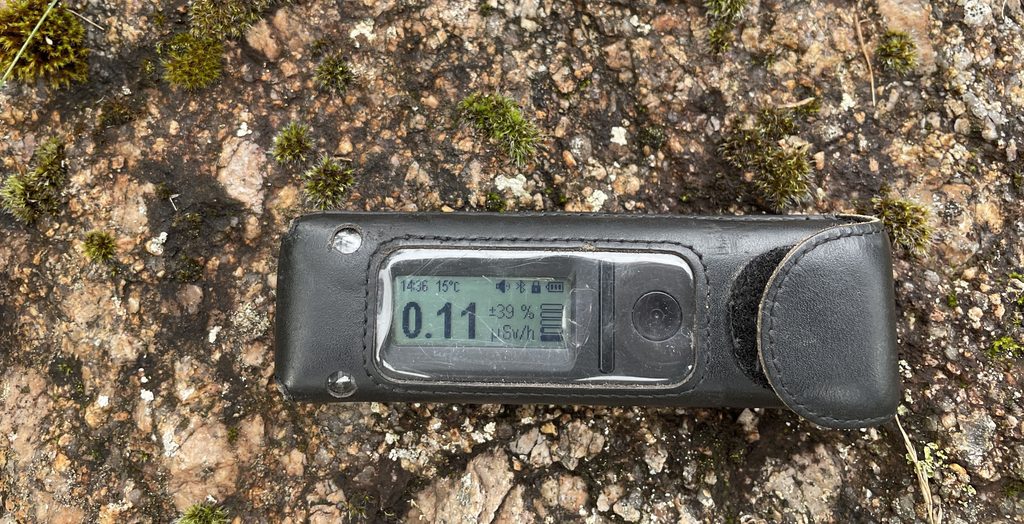
In the hand they were no help either. Pink on some, grey on others, and some that could have been either. Maybe the pile holds both. Only a thin section under a microscope will settle it.
A huge thank you to Karl for his expert knowledge, and not just for showing us the rocks but for diving into modern theories about them. The rock at the Whin Sill may be 297 million years old, but our understanding of it is still in its infancy.