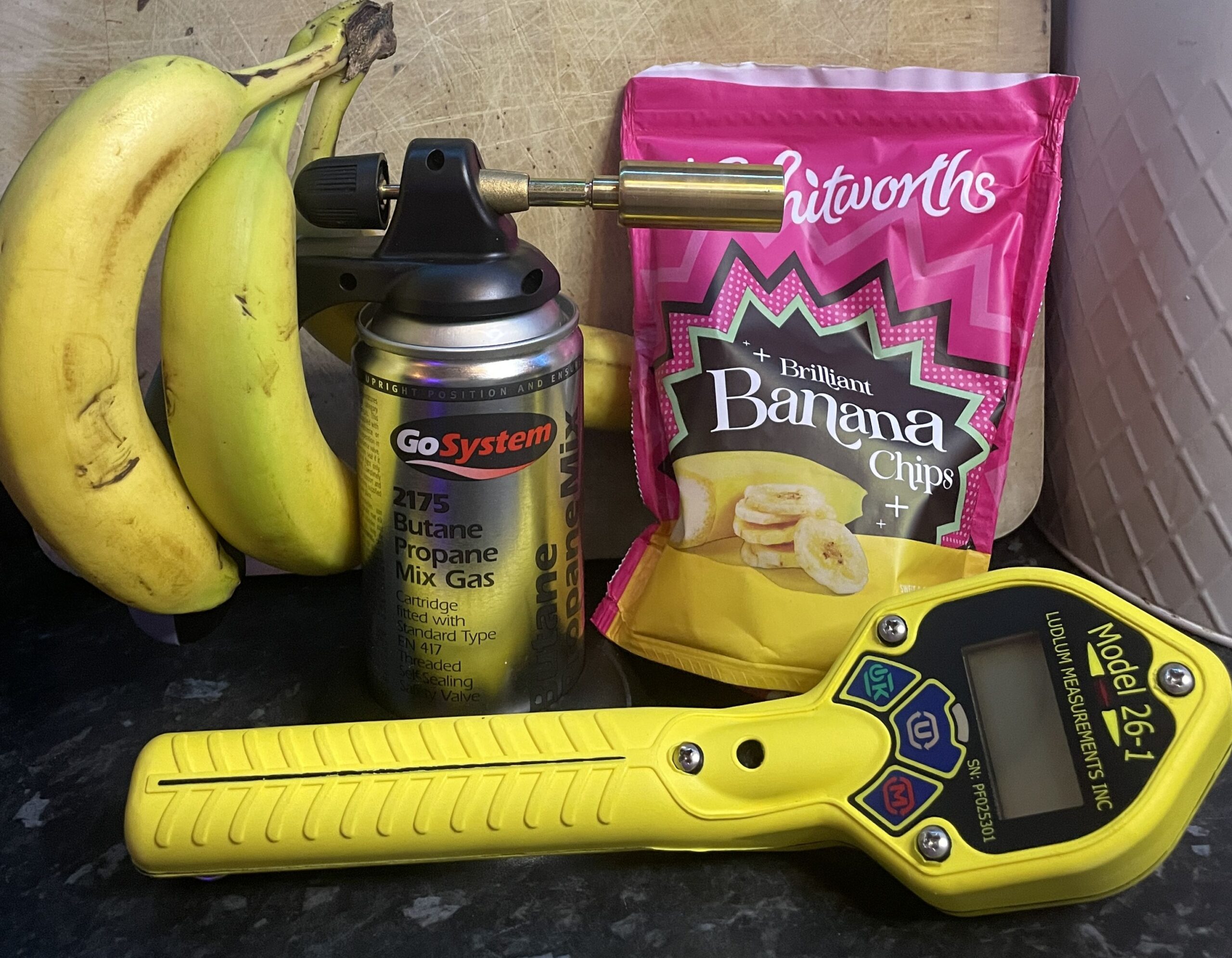
Our Ludlum 26-1 went home this week. Before it went back in its box, we gave it one last job: could it find the radioactivity in a banana?
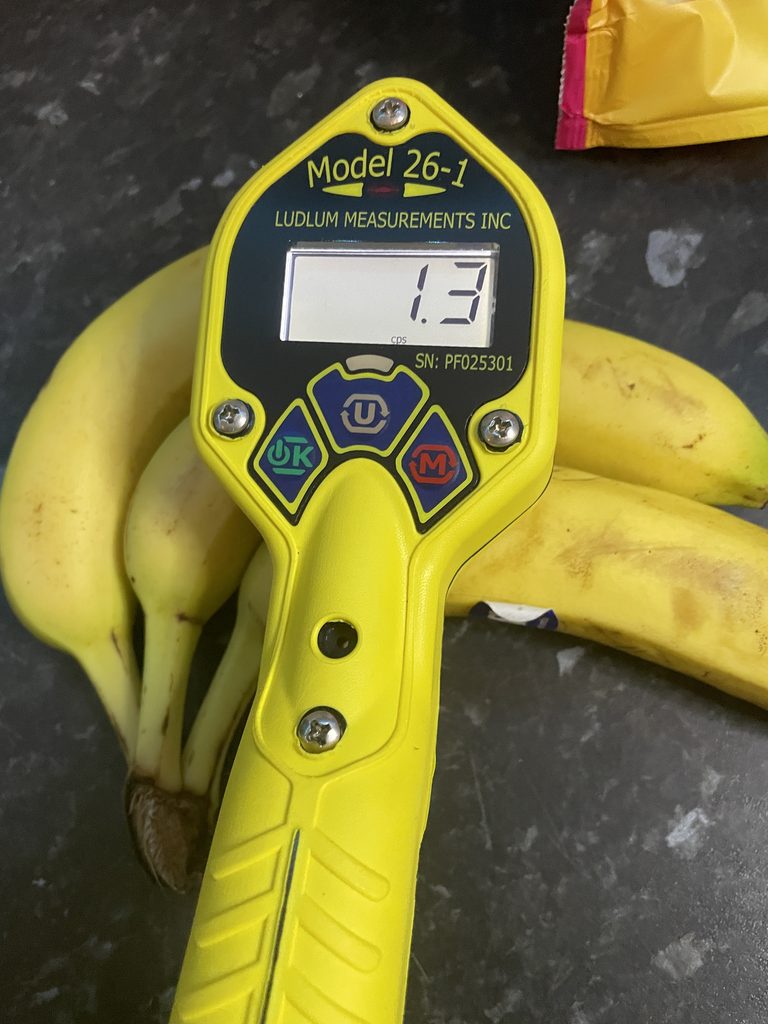
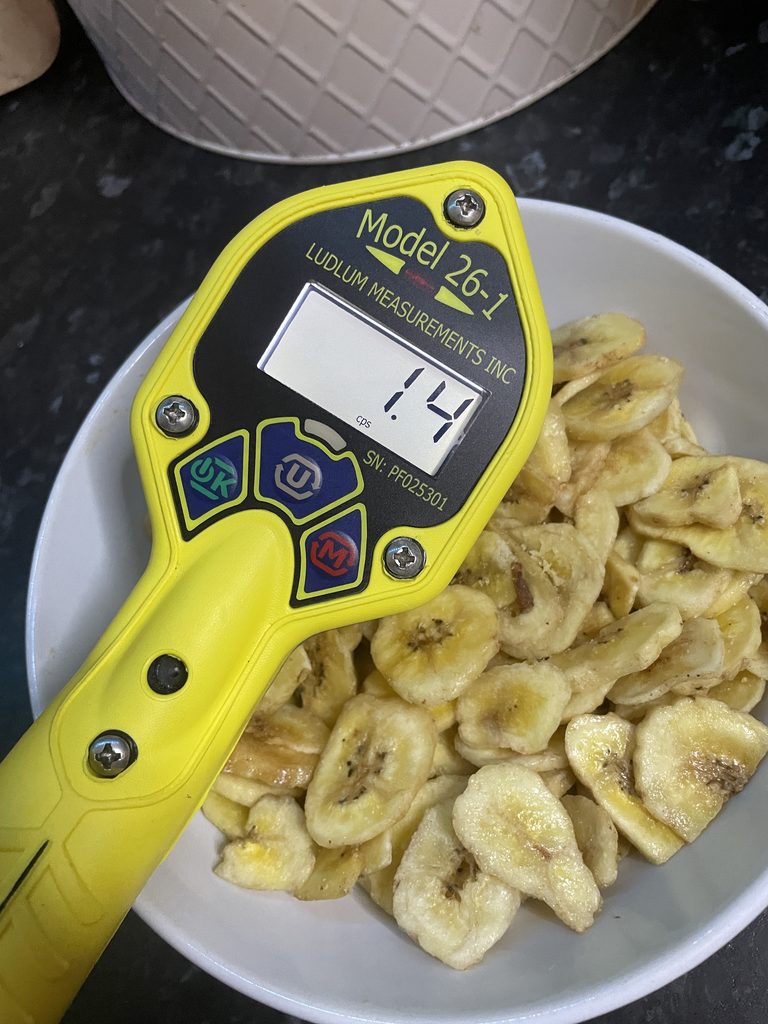
It could not. Not in a whole one. Not in a mashed one. Not in a dried one. It took a blowtorch and a small pile of ash before the counter moved at all, and when it did move, it moved by a factor of two or three over background.
Which is the correct result, and much more interesting than a positive one, because a banana genuinely is radioactive. Both things are true at the same time, and the reason people struggle to hold both is a unit.
The banana equivalent dose is a comparison dressed as a measurement
The banana equivalent dose is the most successful bad unit in science communication. It started as a teaching device in the nuclear industry, a way of saying “this dose is small” to people who had no feel for a microsievert, and it escaped into the wild. Now it turns up in news articles, in arguments about power stations, and in the comments under every radiation video on YouTube.
Nobody receives a banana of dose. The figure behind it is about 0.1 microsieverts of committed effective dose from the potassium-40 in one fruit, and that is a bookkeeping quantity spreading a small risk over the fifty years after you swallow something. It is not the same thing as the dose from a chest X-ray, which arrives all at once from outside your body. Putting them in the same units does not make them comparable, it makes them look comparable, which is worse.
The bigger problem is that it assumes dose stacks, and for potassium it does not. Your body holds around 140 grams of potassium and regulates it within narrow limits, because potassium is what makes nerves and muscles work. Eat a banana and your kidneys excrete the extra, so your own 4,300 becquerels of potassium-40 stays where it has always been. A dose you cannot accumulate is not a dose you can count in fruit.
Then there is the arithmetic, which is where the unit does its damage. A chest X-ray is about 200 bananas. A CT scan is about 100,000. Both are correct and neither tells you anything, because the size of a number is not a measure of harm. The unit gets quoted by people making a dose look trivial and by people making it look enormous, and it serves both equally well, which is not a recommendation.
Here is the comparison that survives. A banana is about 0.1 microsieverts. Background radiation in the UK is roughly 0.3 microsieverts an hour, so one banana is about twenty minutes of being alive. That figure is checkable, it is honest, and it is more vivid than a banana.
Why a banana is radioactive
Potassium. Not the element itself, which is not radioactive at all in the ordinary sense, but the fact that natural potassium is a mixture of three isotopes and one of them is impatient.
Potassium-40 is 0.0117% of all potassium, about one atom in eight and a half thousand. It is primordial, which means it was made before the Earth was, and it has a half-life of 1.25 billion years, so it is still here in every gram of potassium on the planet. That combination sounds like it should be undetectable, and on its own it nearly is.
What rescues it is the atom count. A gram of anything holds a ludicrous number of atoms, so a banana carrying 0.4 grams of potassium is carrying about 47 micrograms of potassium-40, which works out at around twelve decays every second. Twelve, constantly, in a piece of fruit, whether anybody is watching or not.
Potassium-40 decays two ways. About 89% of the time it emits a beta particle and becomes calcium-40, with an endpoint energy of 1.31 MeV. About 11% of the time it does something stranger: it captures one of its own orbital electrons.
Electron capture is worth a paragraph, because it is the reason a mostly-beta emitter shows up in gamma spectra. The nucleus takes an electron from the innermost shell and turns a proton into a neutron. Nothing comes out except a neutrino, which nothing in your house can detect. The vacancy is filled by an outer electron, releasing either an X-ray of about 3 keV or an Auger electron, and the argon-40 left behind is usually excited, so it emits a gamma at 1461 keV.
Which is why the 1461 keV line is the signature of potassium in every spectrum you will ever take. It is also why people assume potassium is a gamma emitter. It is mostly not. Nearly nine decays in ten are beta, and the gamma is a minority report on the last one in ten.
There is one more thing about potassium-40, and it is the thing that matters most here: there is no decay chain. Calcium-40 and argon-40 are both stable. Nothing decays afterwards, nothing builds in, there is no equilibrium to wait for. Uranium and thorium are chains with daughters that grow in over hours and make measurements a moving target. Potassium is one step and a full stop, so a reading of potassium is the reading, immediately, every time.
Everything else with potassium in it
Bananas are famous for exactly the wrong reason, because they are not even the interesting case anyone could have chosen.
Lo Salt and the other salt substitutes are potassium chloride, usually about two thirds of the tin, which makes them about 11 becquerels per gram. A hundred grams is over a thousand becquerels and reads like a lamp. Same element, same decay, no water in the way. We used it in a previous video and it is still the most honest demonstration in the collection.
Brazil nuts are the fun one, because they concentrate radium as well as potassium. Simon of Simon’s Nuclear Chemistry actually extracted the radium out of them, in a video that is worth ten minutes of anybody’s time: https://youtu.be/SVmCwGDVsDg. The amounts are trivial, measured in becquerels per kilogram, and if that gets written badly it becomes a scare story, so: trivial. They are also delicious, which is a better reason to eat them than a reason to avoid them.
Beyond that: potatoes, beans, dried apricots, spinach, milk, coffee, and every other plant grown in soil with potassium in it, which is every plant. Outside the kitchen, granite worktops, potash fertiliser, and feldspar in concrete. There is no such thing as a radioactive food. There is a number per kilogram, and it applies to all of it, and to you.
How we tested it
The instrument matters here, because we were using the wrong one on purpose.
A pancake probe is a frisking tool. It is built to find contamination on a surface, where the activity is in the top micron of whatever you point it at, and it is very good at that. A banana is the opposite problem: bulk, wet, low density, activity spread all the way through. The probe sees the top two millimetres and nothing else.
We counted in the instrument’s own sixty second mode, five times per sample, with five counts of background first. Background was about one count a second, which is mostly potassium and friends in the concrete and in us.
Whole banana: nothing, within the noise. Mashed flat, to rule out bad geometry: nothing. Dried, on the grounds that water was the enemy: still nothing.
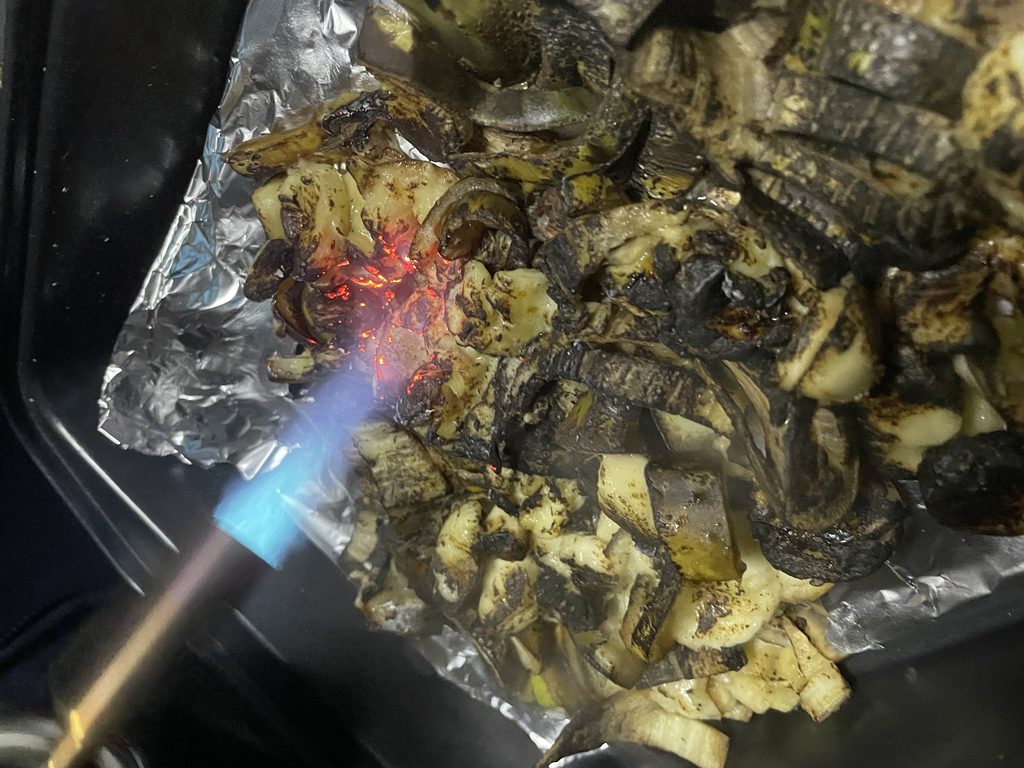
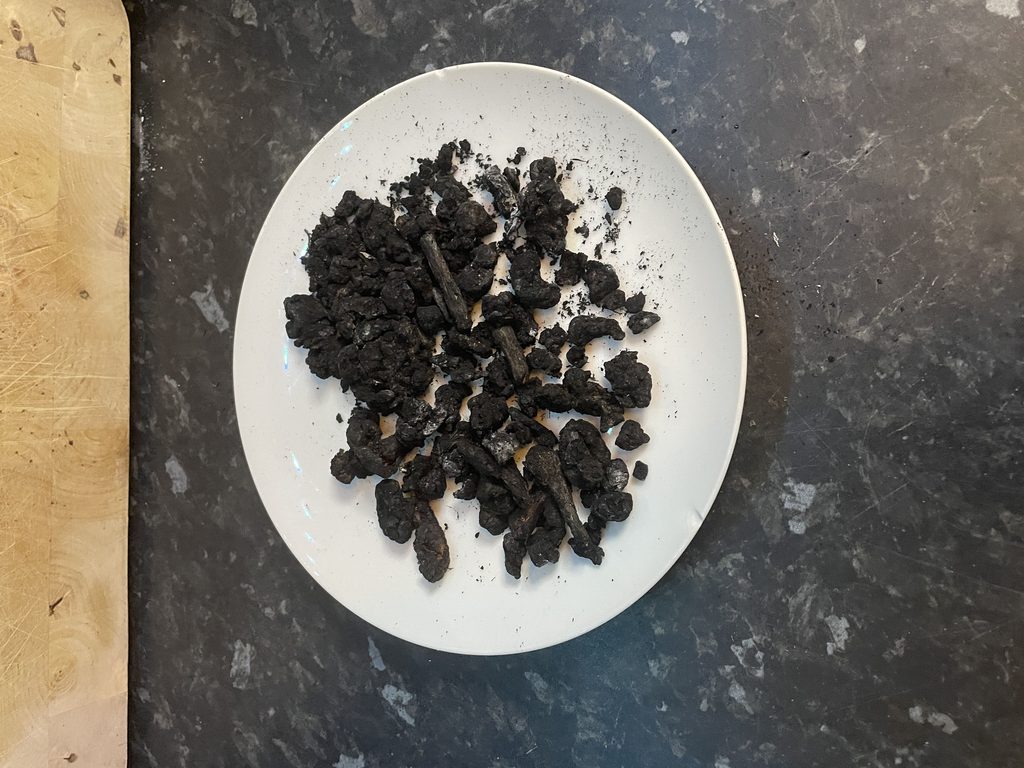
Then Mrs UH’s blowtorch, a stainless tray, and a kilogram of banana reduced to about nine grams of ash. That read two to three times background, five times out of five.
The reason is simple once you have the numbers. A kilogram of banana carries about 3.4 grams of potassium, which is 105 becquerels, but those betas only escape from the outer couple of millimetres and the rest are absorbed by the fruit’s own water. Burn the water off and the same activity is sitting in a thin layer of powder directly under the window.
In a laboratory you would go further and burn it to potassium carbonate, which is what the ash mostly is. We did not, because it is caustic, it is hygroscopic, and it is not a thing to be making in a kitchen for a video about fruit.
So eat the banana
You will absorb some radioactivity. Nothing will happen, which is the least dramatic possible result and also the correct one.
You were already radioactive anyway. Your own potassium is about 4,300 becquerels, your carbon-14 about 3,700, so roughly eight thousand decays a second, constantly, in a body that notices none of them. The water in you carries a trace of tritium, and there is even a whisper of natural plutonium in there, under a hundred thousand atoms, which is less than a millionth of a becquerel and the sort of fact that makes a good headline on a slow news day.
Which is the real reason the banana equivalent dose was the wrong tool from the start. It invites you to compare yourself with a piece of fruit, when you are, in fact, the source.
The test is in the Short: https://youtube.com/shorts/pMU5E4mLfm4
The full detector review is here: https://youtu.be/qJo9hupe5Wg
Simon’s Brazil nut radium: https://youtu.be/SVmCwGDVsDg